
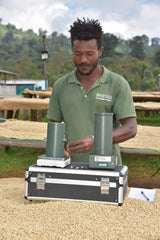


A washed coffee of Q1 quality, certified organic
Aman Adinew founded Metad in 2010, and coffee production began three years later. His brother, Tariku Adinew, joined the company shortly afterward. In Hambela, Metad owns a 200-hectare farm located in the Hambela Wamenna woreda, specifically in the Alaka and Bishan Fugu kebeles.
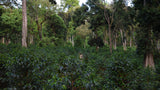
The farming system used on these plots follows Ethiopia’s well-known semi-forest model. The landscape is rich in natural forest, with native climax tree species still present, such as qararo (Aningeria adolfi-friederici). The farm is organized into plots, and each plot is planted with a single coffee variety. The varieties grown include: 75227, 74112, 74110, and 74140. The farm is organically managed, with all coffee cherries harvested by hand.
The cherries are pulped using a Penagos eco-pulper the morning after harvest. This machine removes the mucilage and significantly reduces the amount of water needed to wash the parchment. After pulping, the parchment coffee is soaked for one day before being spread out on drying tables.
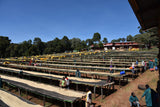
Drying takes place on traditional African raised beds, and thanks to the high altitude (over 2,000 meters) and the favorable orientation of the wet mill, optimal drying conditions are achieved. The drying process typically lasts between ten and fifteen days.
Belco and Metad have been working together since 2018, united by a shared vision of quality, environmental responsibility, and respect for the people involved throughout the coffee value chain.
Here are a few words from Tariku Adinew:
"METAD wants to make our community happier and healthier, and we pride ourselves on implementing ethically and socially responsible practices across our company. A portion of all profits are reinvested back into the community, going towards the building of clinics, roads and digging wells for safe drinking water, among other initiatives. We have adopted a local elementary school, providing over 850 students with much needed supplies and financial support, we also provide University scholarships to 105 disadvantaged students from our area, and we’ve partnered with Grounds-for-Health, a US-based NGO working with coffee farming communities to eradicate cervical cancer in women. Over 70% of METAD’s current farm workforce are women."
Terroir Hambella
Perched between 2,100 and 2,200 meters above sea level, Hambela lies in the Guji zone, in southern Ethiopia. This region stands out for its rich biodiversity, fertile soils, and cool climate, creating ideal conditions for producing exceptional coffees. Hambela is not just a place, it’s a living ecosystem, where indigenous trees, ancestral traditions, and high-altitude terroir come together to reveal the full potential of Ethiopian Arabica.
In the villages of Alaka, Korchema, and Goyo, coffee is grown under organic and semi-forest systems that preserve native shade trees such as Aningeria adolfi-friederici (qararo). These natural canopies protect the coffee plants and contribute to the preservation of both forests and soils.
Region Guji
The origins of coffee in Guji go back several centuries, with wild varieties growing naturally in the region's forests. Local communities, mainly of the Oromo ethnic group, used coffee in their traditional practices long before it was commercially exploited.
For a long time, the Guji appellation was included in the Sidama appellation. In order to better distinguish the quality of the coffee produced here, this designation was separated by the Ethiopian authorities in the 2000s. This new designation makes it possible to refine the traceability of Ethiopian coffees and, above all, to better reflect their quality in terms of taste and typicality in the cup.
Today, the Guji appellation produces some of the finest coffees in the world. Coffee here is an ancient crop, grown on hilly plateaus in a dense forest or semi-forest environment, where the diversity of endemic species provides optimal shade for the coffee trees and contributes to the fertility of the soil.
About Metad
Metad was created at the initiative of a family long involved in coffee production, since the grandparents of its founder, Aman Adinew, were themselves coffee producers and traders. Before Metad, Aman Adinew was President of the ECX (Ethiopia Commodity Exchange).
He created Metad with other members of his family who were American citizens, but who, like him, had chosen to return home driven by a desire to develop an efficient, quality business. Aware of the potential shortcomings of the Ethiopian coffee sector, they have chosen to promote remarkable coffees while focusing on traceability, ensuring better recognition of the products of their region.
METAD supports various local social and environmental projects. It organises regular training courses and pays coffee farmers advances, making their situation more stable. The group has also distributed over 600,000 coffee seeds to the farmers it works with. More generally, METAD has helped to build roads and provided funding for new primary schools, covering all expenses for 800 pupils (equipment, teachers’ wages, etc.). It offers scholarships for 105 disadvantaged students in the region of Gedeo, and runs projects aimed at supporting farmers’ wives, particularly in terms of disease prevention and screening.
Our packaging is made of 100% recyclable plastic.